Most of the legal paperwork comes after the move, but a few jobs have to happen before the van arrives. The sections below follow that order. For the hour after the van leaves, the first-hour checklist takes over.
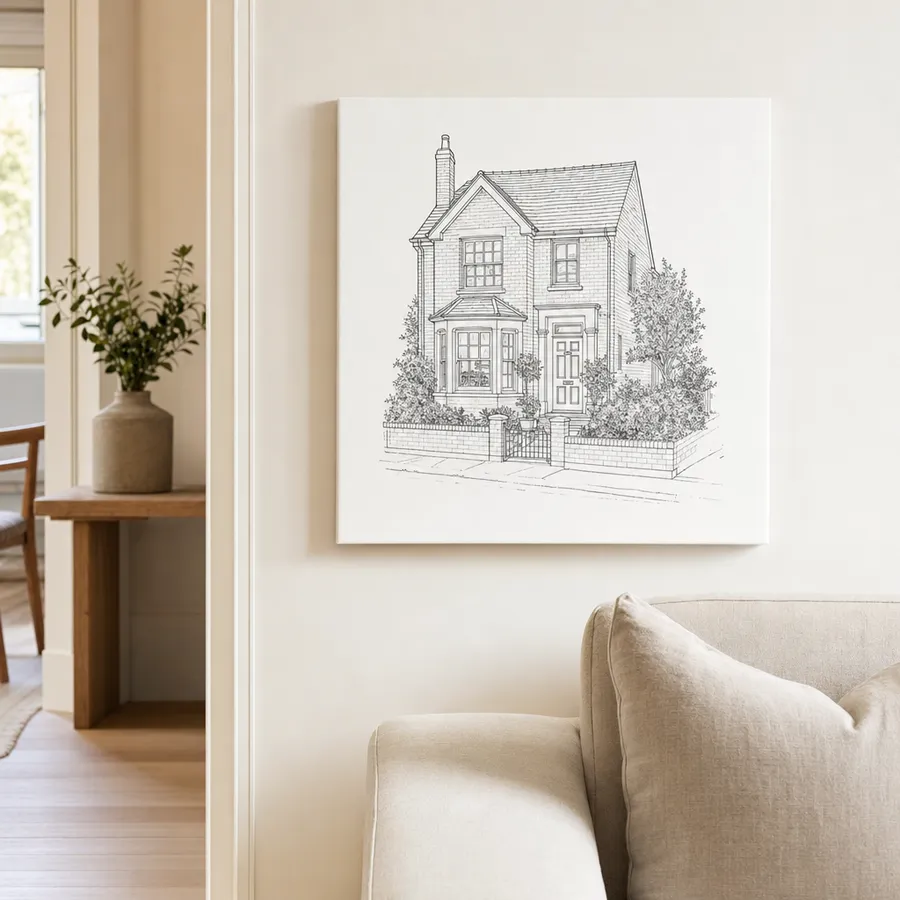 The House Illustration From £19.99
One photograph of the front of the house, restyled into an illustration. The watermarked preview is free.
From £19.99 · Poster
See this printSee all sizes and pricesAs soon as you have a date
- Book the removal firm. Earlier than feels necessary is about right; a date you've held for weeks beats a cheaper quote you can't get.
- Tell your gas and electricity supplier you're leaving. Citizens Advice says "you should give at least 48 hours' notice", and asks for a forwarding address so the final bill reaches you (Citizens Advice).
- Set up mail redirection with Royal Mail.
- Find your new local council with GOV.UK's find your local council tool, and contact it about Council Tax. GOV.UK's Council Tax page says "Contact your local council if you're unsure about whether you can get a discount or who's responsible for paying" (GOV.UK).
- Register with a GP near the new address if you're moving within England. The NHS says you can do it online, and that you "do not need to tell your current GP surgery if you're changing" (NHS).
The week before
- Pack room by room, and label each box with the room it's going to rather than what's inside. The person carrying it needs to know where to put it down.
- Pack one box for the kettle, chargers, toiletries and bedding, and put that one in the car rather than the van.
- Put passports, jewellery and anything irreplaceable in a bag that travels with you.
Moving out
- Read your meters on the day. Citizens Advice says to "read your meters on the day you move out and give the readings to your supplier", and to keep a note of the readings and dates in case you don't agree with the final bill (Citizens Advice).
- If you have a smart meter in-home display, leave it. Citizens Advice says to "leave your in-home display for the next people who will live in your home" (Citizens Advice).
Moving in
- Read the meters again and give the readings to the supplier at the new address: "Read your meters on the day you move in and give the readings to the current supplier" (Citizens Advice).
- If the new home has a prepayment meter, contact the supplier straight away. Citizens Advice says to try not to use a key or card, or put any money on the meter, until you have (Citizens Advice).
- Work through the first-hour checklist: stopcock, fuse box, kettle box.
Change of address: who to tell in the first weeks
- Update the DVLA. GOV.UK: "You must update your driving licence, vehicle log book (V5C), Direct Debit for vehicle tax and other details when you move home." Changing the licence address costs nothing (tell DVLA, change your licence address).
- Register to vote at the new address. GOV.UK says "You'll need to register again if you've changed your name, address or nationality", and that it usually takes about 5 minutes (register to vote).
- Update your TV Licence if you have one. GOV.UK says that if you move home you can update your address on the TV Licensing website (GOV.UK).
- Tell HMRC. GOV.UK: "You need to tell HM Revenue and Customs (HMRC) if you've changed your name or address" (GOV.UK).
We've left off banks, employers and schools because each has its own process and we didn't find an official page to point you to. They belong on your own list.
This is the first page of the move. The moving house tips cover the day itself, and if you're buying rather than renting, the first-time buyer checklist runs before all of this. Once the boxes are inside, what to do first in a new home picks up where this stops, and a moving house gift made from a photo of the new front door marks the day.
All quotations read on the linked pages on 1 October 2026.